Introduction
Cyberattacks are becoming more frequent and sophisticated. From data breaches to ransomware, businesses are constantly at risk. To prevent these threats, organizations must take a proactive approach to security. One of the most effective strategies is Vulnerability Assessment and Penetration Testing (VAPT).
VAPT not only identifies weaknesses but also simulates real-world attacks to determine how secure your digital assets truly are. This blog will walk you through what VAPT is, why it matters, the process, types, tools, and real-world examples to help you understand its importance.
What is VAPT?
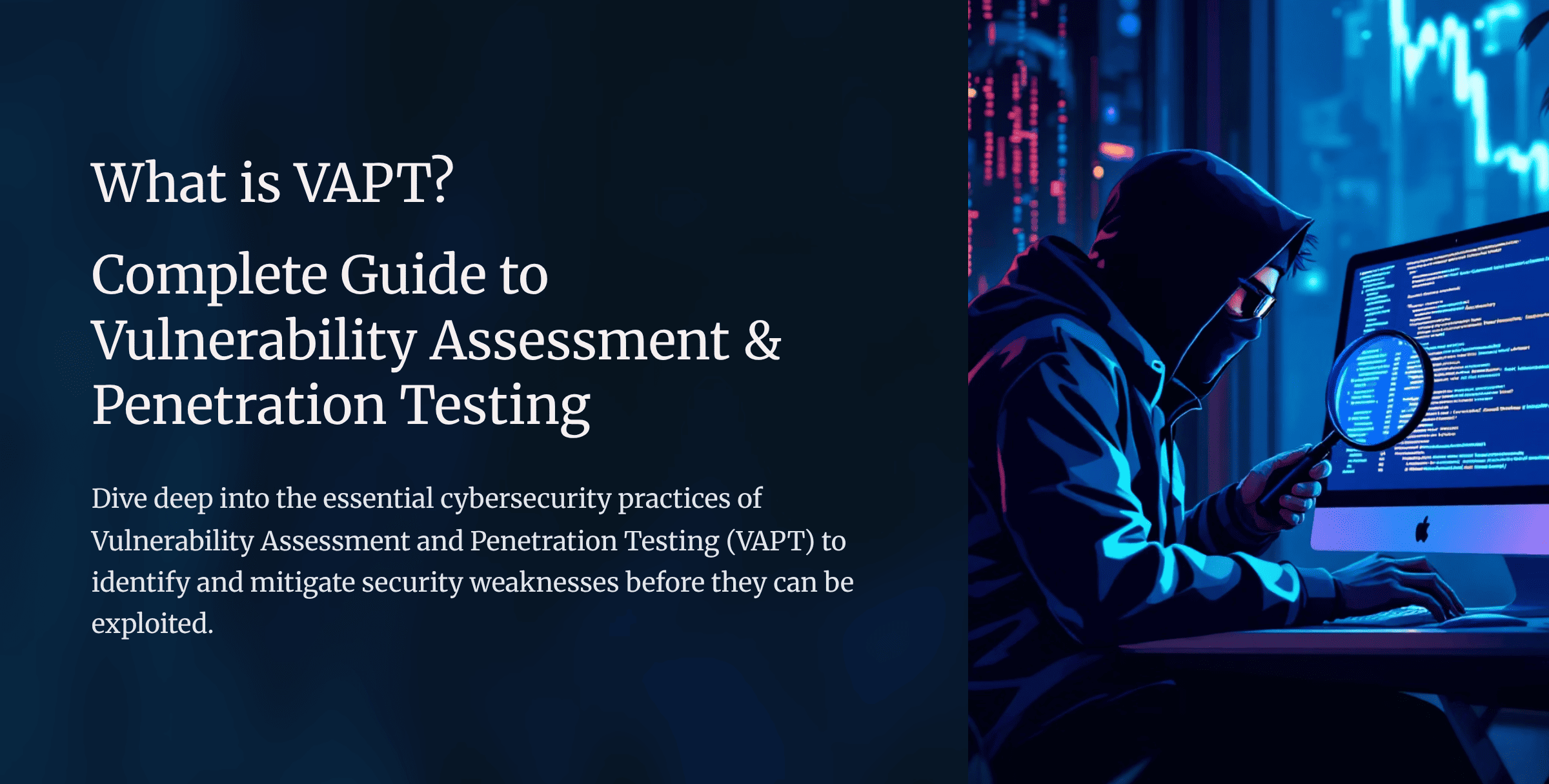
VAPT (Vulnerability Assessment and Penetration Testing) is a combination of two key processes:
Vulnerability Assessment (VA): Scanning systems, applications, and networks to identify security flaws.
Penetration Testing (PT): Actively exploiting those flaws in a controlled manner to see the potential damage.
Together, they give organizations a complete picture of their security posture — detection plus validation.
Example: A vulnerability scan might detect that a web application has outdated software, but a penetration test confirms whether it can be exploited to steal sensitive customer data.
Why is VAPT Important?
Proactive Defense: Stops hackers before they strike.
Regulatory Compliance: Required for standards like ISO 27001, PCI DSS, HIPAA, and GDPR.
Business Continuity: Prevents downtime, financial loss, and reputational damage.
Customer Trust: Shows clients and partners that you value data security.
Scenario: A fintech startup running API-based services must undergo regular VAPT to comply with PCI DSS and avoid breaches that could compromise financial data.
Types of VAPT (With Real-World Scenarios)
1. Network VAPT
Focuses on securing internal and external network infrastructure like routers, switches, and firewalls.
2. Web Application VAPT
Examines websites and web apps for vulnerabilities such as SQL Injection or XSS.
3. Mobile Application VAPT
Tests mobile apps for flaws on iOS and Android.
4. Cloud VAPT
Ensures security of cloud services (AWS, Azure, Google Cloud).
5. API VAPT
Secures application programming interfaces that connect apps.
Popular Tools Used in VAPT
Burp Suite: Web application testing.
Scenario: Used to test a login page where session tokens were not properly invalidated, exposing user accounts.
OWASP ZAP: Open-source web security scanner.
Scenario: Integrated into CI/CD pipelines to automatically flag Cross-Site Scripting (XSS) during development.
Nmap: Network mapping and scanning.
Scenario: Reveals an open SSH port with default credentials in a corporate server.
Metasploit: Exploitation framework.
Scenario: Used to simulate an attack on an outdated SMB protocol, gaining administrator-level access.
Wireshark: Network traffic analysis.
Scenario: Helps identify unusual outbound traffic indicating malware data exfiltration.
OpenVAS: Vulnerability scanning tool.
Aircrack-ng: Wi-Fi security testing.
Nessus: Vulnerability management solution.
SQLmap: Automated SQL injection exploitation.
Acunetix: Web application security scanner.
VAPT Process – Step by Step
Planning & Scoping – Define target systems and goals.
Example: A healthcare provider decides to test only its patient portal and database systems.
Information Gathering – Collect technical details about systems.
Example: Nmap is used to identify all active hosts and open ports in the environment.
Vulnerability Scanning – Automated tools detect known flaws.
Example: Nessus detects outdated SSL certificates in a corporate web app.
Exploitation (Penetration Testing) – Ethical hackers attempt real attacks.
Example: Using Metasploit to exploit a weak FTP service and gain file access.
Reporting – Detailed documentation of findings, risks, and fixes.
Example: Report shows “High Severity” SQL Injection in the login form with recommended fixes.
Remediation & Re-testing – Patch vulnerabilities and validate fixes.
Example: Developers apply input validation, and a second round of testing confirms the SQL Injection is resolved.
Best Practices for Effective VAPT
Perform VAPT regularly (at least every 6–12 months).
Combine automated scanning with manual testing for deeper insights.
Keep up with the latest OWASP Top 10 vulnerabilities.
Prioritize remediation instead of only detection.
Engage certified professionals (CEH, CPENT, OSCP, etc.) for advanced testing.
Conclusion
In a world where cyberattacks are constant, VAPT is a business necessity. By identifying vulnerabilities and simulating real attacks, organizations can secure critical systems, meet compliance requirements, and build customer trust.
Whether you run a small startup or a large enterprise, regular VAPT assessments ensure that your digital defenses remain strong and resilient.