Introduction
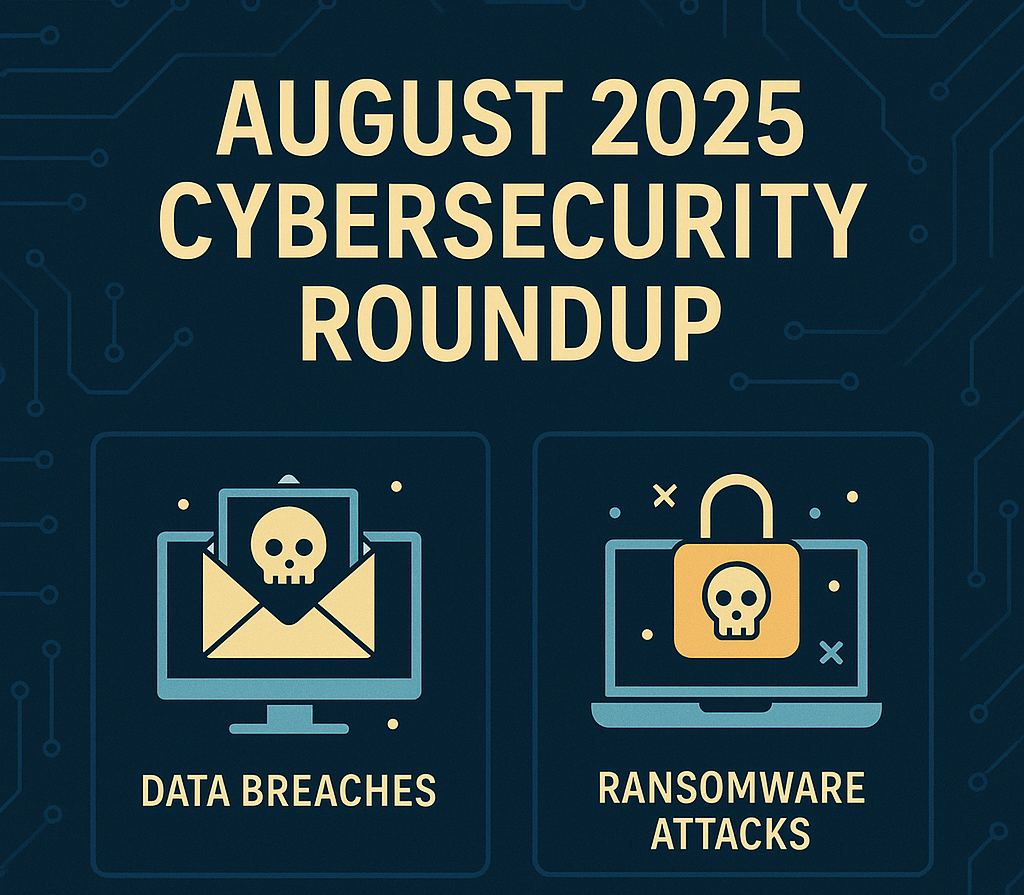
August 2025 has been a turbulent month in cybersecurity. From massive data breaches and ransomware shutdowns to emergency browser patches and sophisticated malvertising campaigns — organizations across industries have faced elevated risks. Here’s your comprehensive roundup of major incidents and trends.
1. Massive Data Breaches & Ransomware Disruptions
Google Gmail Data Breach & Vishing Surge
A group known as ShinyHunters (UNC6040) tricked a Google employee to infiltrate their Salesforce database, affecting approximately 2.5 billion Gmail accounts. Although passwords weren’t exposed, personal contact details were leaked, triggering a wave of vishing attempts targeting users News.com.au.
Inotiv Hit by Ransomware (Qilin)
Inotiv, a U.S.-based pharmaceutical and biotech company, was struck by ransomware on August 8, 2025. The Qilin group encrypted key systems and reportedly exfiltrated ~176 GB of data (~162,000 files), forcing partial IT shutdowns and emergency containment measures TechRadar.
iiNet Data Breach (Australia)
Telecom provider iiNet disclosed that attackers used stolen employee credentials to infiltrate their order management system, exposing 280,000 email addresses, 20,000 landline numbers, and 1,700 modem setup passwords. No financial data was compromised, and iiNet began notifying affected customers on August 16, 2025 News.com.au.
2. Targeted Infrastructure Attacks
Colt Ransomware Attack (UK Telecom)
On August 12, Colt Technology Services fell victim to a ransomware attack by the Warlock gang, exploiting a SharePoint vulnerability (CVE-2025-53770). Systems taken offline included the Colt Online portal and Voice API. Stolen data—several hundred gigabytes including contracts, salary info, and architecture diagrams—was listed for sale on a Russian Tor forum IT Pro.
3. Emergency Patches & Vulnerability Fixes
Google Chrome High-Severity Flaw
A critical vulnerability discovered on August 4 by Google’s “Big Sleep” AI tool prompted an emergency update on August 19. The flaw could allow hackers to crash the browser and overwrite sensitive data across devices. As of the alert, over 3 billion malicious email attacks had also been detected The Sun.
Microsoft August Patch Tuesday
Microsoft released fixes for 107 vulnerabilities, including 13 critical ones and one zero-day. The most common issues addressed were elevation of privilege (39%) and remote code execution (33%) CrowdStrike.
4. Emerging Attack Techniques & Campaigns
Cookie Spider & Kernel-Level Exploits
A malvertising campaign by “Cookie Spider” targeted over 300 entities using Atomic macOS Stealer (AMOS) and the SHAMOS variant. Other threats included the CORNFLAKE.V3 backdoor (linked to UNC5518/5774) and “RingReaper”, a novel kernel exploit that abuses Linux’s io_uring feature to evade traditional EDR systems Cyware Labs.
Nation-State & Espionage Activity
Analyzed data revealed North Korea’s APT Kimsuky deploying XenoRAT malware against diplomatic missions. Meanwhile, complex breaches exploiting Microsoft SharePoint (CVE-2025-53770) were traced to state-sponsored actors, including a breach at Canada’s House of Commons Cyware LabsFireCompass.
5. Proactive Defenses & Sector Alerts
CIRO Threat Mitigation (Canada)
The Canadian Investment Regulatory Organization (CIRO) identified a cybersecurity threat on August 11 and proactively shut down certain systems while ensuring critical operations continued FTF.
Illinois Botnet Arrest & U.S. Sentencing
A 22-year-old from Oregon was arrested for operating “Rapper Bot”, a large-scale DDoS network tied to a March attack on X/Twitter. Separately, a core member of the “Scattered Spider” group in Florida received a 10-year federal sentence and a $13 million fine Mass.gov.
Conclusion & Key Takeaways
August 2025 highlighted how cyber threats are diversifying and intensifying. Organizations must:
Prioritize patch management, especially for zero-days and SharePoint-related vulnerabilities.
Segment IT infrastructure to limit lateral movement during breaches.
Combat social engineering and vishing through employee awareness and multi-factor authentication.
Monitor for advanced threats—kernel-level exploits and malvertising campaigns require layered defense.
Embrace proactive incident response and disruption tolerance, as demonstrated by CIRO and Inotiv.